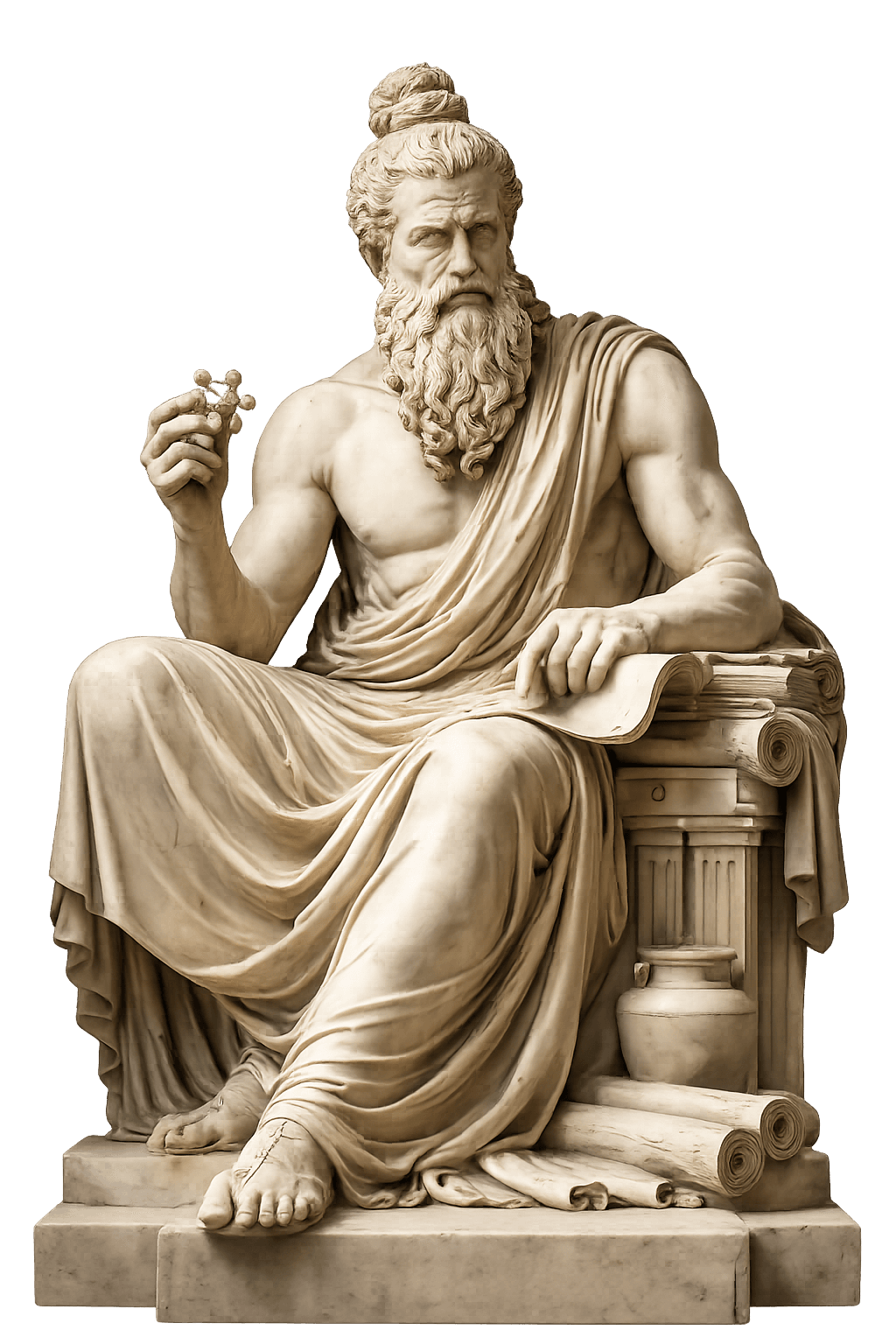
Nature is the deepest problem we know. It is also the only one worth solving for its own sake.
Every leap in human civilization has come from the same place. We understood something about nature we had not understood before. Fire. Iron. Steam. Electricity. The atom. DNA. Each new understanding rewrote what was possible, and each began with a model - a way of describing what nature was doing - that was good enough to do something with.
This is what simulation is. It is the act of building a small, faithful picture of reality, and then learning from that picture things the real world has not yet let us see.
We believe in this completely. We believe the next chapter of human civilization will be written by people who can simulate nature better than we ever have.
Experiment is slow. Simulation is fast.
For most of history, the only way to test an idea about nature was to do an experiment. Build the apparatus. Run the trial. Wait. Measure. Repeat. It worked, and it cost enormously - centuries of effort, lifetimes of work, billions of dollars, whole institutions built around a single molecule or a single material.
Then AlphaFold happened. Decades of protein crystallography, billions of dollars, thousands of careers - and the field had solved roughly a hundred and fifty thousand structures. AlphaFold released two hundred million in a year.
That is not a marginal improvement. That is a phase change. The bottleneck was never the scientists. The bottleneck was the experiment. Replace the experiment with a faithful enough simulation and the field moves at a speed that used to be physically impossible.
That phase change is coming for the rest of science. Chemistry. Materials. Catalysis. Drug discovery. Energy. Each of them is, at heart, a problem of nature - and each of them is waiting for the simulation that will do for it what AlphaFold did for proteins.
Beyond chemistry
Chemistry is the first thing computationally revolutionizing, because chemistry is the most tractable case of "many interacting quantum particles." It is not the last.
If we can compute the forces on a particle, we can move it through space. If we can move particles through space by the rules they actually follow, we have a small piece of the real universe living inside a computer. From there, the questions get larger. What did the first microseconds after the Big Bang look like? Why does matter outnumber antimatter? What states of matter exist that we have never seen on Earth, because the conditions to create them have never existed here?
Quantum field theory on a quantum computer is a real research program. Early-universe simulation is a real research program. Antimatter physics is a real research program. We work on all of them. We think they will repay the investment many times over, and we think some of the answers will surprise us.
The current landscape
The quantum hardware is being built by people doing some of the most important work of our time. IBM, Google, Quantinuum, IonQ, Rigetti, QuEra, D-Wave - each of them has carried the field forward. IBM and Google in particular have spent the last decade proving, one experiment at a time, that the machine works.
But the experiments that come out of those labs are, by and large, run by those labs and a small set of close collaborators. The hardware is open in principle and narrow in practice. A chemist with an interesting molecule, a biologist with an interesting protein, a materials scientist with an interesting alloy - most of them still have no way to put their question on a quantum computer and get an answer back.
That is the gap we exist to close. And in current AI age GPU and other architecture is also accelerating the compute power, the combination os these architectures will allow us to simulate the nature in a much accurate and faster way than before.
A cycle of discovery
We are in mission to build systems that can help us bring our imaginary properties of matter into reality. We are building a cycle of discovery that starts with a question, simulates the answer, and then tests that answer in the real world.
The cradle
Tsiolkovsky wrote that the Earth is the cradle of humanity, and a cradle is not a place you stay forever.
Every new form of matter we discover is a small step out of the cradle. New materials for spacecraft we have not built. New chemistry for environments we have not yet survived. New medicines for problems we cannot currently solve. New physics that pulls us closer to an honest explanation of why the universe is the way it is.
There are millions of forms of matter we have never seen. The space of possible molecules, possible materials, possible exotic states of matter is staggering. With classical computation we have explored a corner of it. With quantum computation - done openly, by the people who actually need the answers - we have a chance at the whole map.
That is what we are building toward. We are not promising the next civilizational leap will come from us. We are promising that if it comes, it will come faster, and to more people, and from more places, than it would have otherwise.
That is the bet. That is the work.
That is what DeepRealm is for.